In wire, cable, and pipe manufacturing, the CIJ ink you choose is a critical process parameter. The wrong ink smears on fast-moving lines, fails to adhere to low-energy plastics, or fades under UV exposure -- costing you downtime, scrap, and compliance failures. This guide covers the key factors to get the selection right.
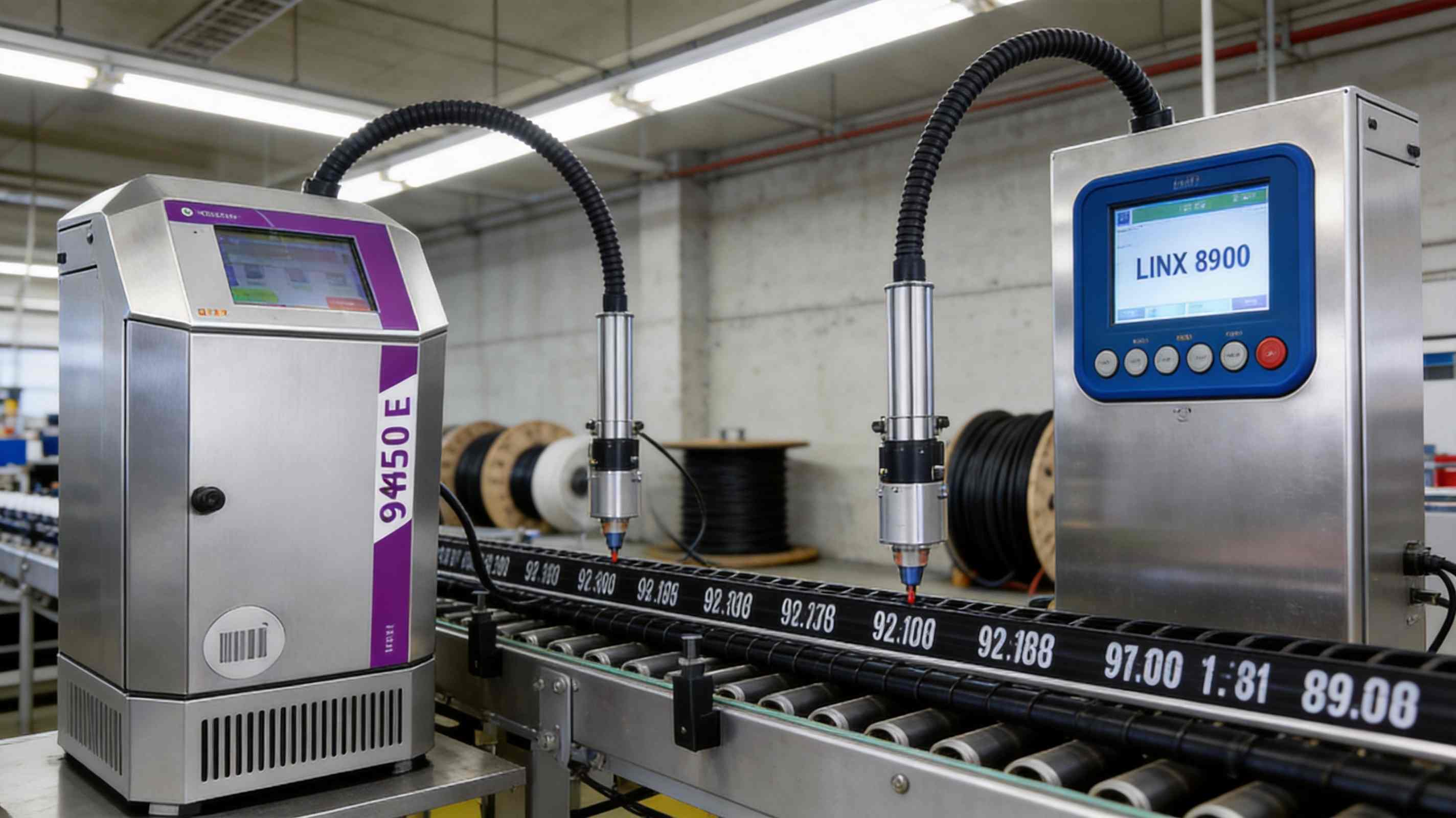
Fig. 1 — Markem-Imaje 9450E (left) and Linx 8900 (right) coding on a cable extrusion line
1
Know Your Substrate
The substrate is the single most important factor. Its chemical composition and surface energy determine which inks will adhere and dry properly.
| Substrate |
Surface Energy |
Recommended Ink |
| PVC (cable jacket) |
Moderate |
MEK-based pigmented |
| PE / HDPE (pipe) |
Low |
MEOH-based or specialty low-energy ink |
| PP (pipe, conduit) |
Low |
MEK/acetone blend with adhesion promoter |
| XLPE (cable insulation) |
Low-Moderate |
MEK-based pigmented |
| Nylon (cable jacket) |
Moderate |
MEK or ethanol-based pigmented |
| Metallic (armored cable, steel pipe) |
High |
MEK-based pigmented |
Key Principle
Never assume one ink works across all substrates. Test every ink-substrate combination before committing to production.
2
Pigmented vs. Dye-Based Ink
This is the most consequential chemistry decision for extrusion applications. It affects contrast, durability, and printhead maintenance.
Dye-Based Ink
- ✔ 30–50% lower cost
- ✔ Easier on printheads, fewer clogs
- ✖ Poor UV resistance -- fades in weeks
- ✖ Low opacity on dark surfaces
- ✖ Wears off during cable winding
Pigmented Ink
- ✔ Excellent opacity -- white on dark cable is standard
- ✔ Superior UV and abrasion resistance
- ✖ 2–3x more expensive
- ✖ Higher clogging risk -- needs frequent filtration
3
Solvent Base & Drying Speed
The solvent determines drying speed, substrate compatibility, and printhead health. Match drying time to your line speed -- at 100 m/min, ink must dry within ~0.5 s before hitting the next roller.
| Solvent |
Drying Speed |
Best For |
Note |
| MEK |
Very fast (<1 s) |
PVC, nylon, rubber, metal |
Industry workhorse. Strongest adhesion. |
| Ethanol |
Fast (1–2 s) |
PVC, treated PE/PP |
Gentler on printheads. Less effective on low-energy plastics. |
| Acetone |
Extremely fast (<0.5 s) |
PP, PE |
Fastest option. May crack some plastics -- often blended. |
| Blended |
Tunable |
Engineered per substrate |
Best for challenging materials. Recommended. |
Line Speed Tip
When in doubt, choose a faster-drying formulation. It's easier to adjust printhead distance than to slow the line down.
4
Environmental & Durability Needs
Cables and pipes serve in harsh environments. The ink must match the product's service conditions.
| Requirement |
Application |
Solution |
| UV Resistance |
Outdoor cables and pipes |
Pigmented ink with UV stabilizers |
| Abrasion Resistance |
Cable winding, conduit pulling |
Pigmented ink; verify with tape test |
| Chemical / Oil Resistance |
Automotive, marine environments |
Cross-linking or solvent-resistant formulation |
| Halogen-Free |
Railway, mining, building cables |
Halogen-free ink; must not compromise cable cert |
| Temperature Resistance |
Hot water pipes, engine bays |
Thermally stable pigments (up to 150°C) |
Compliance Warning
For certified cables (UL, CSA, VDE, CCC), the ink may need to be on the approved material list. Using unapproved ink can void the cable's certification. Always verify before switching.
5
Color & Contrast
Readability is non-negotiable. Marks must be legible under real-world conditions, not just ideal factory lighting.
| Substrate Color |
Ink Color |
Reason |
| Black, dark gray, brown |
White (pigmented) |
Highest contrast. Industry standard for cables. |
| White, light gray, beige |
Black (pigmented) |
Standard for pipes. Universally readable. |
| Red, blue, green |
White (pigmented) |
Best contrast on colored cables. |
6
Coder Compatibility
Not every ink works in every CIJ coder. Key compatibility parameters:
- Viscosity: Typically 3–6 cPs at operating temperature. Out-of-range values cause poor droplet formation.
- Conductivity: Must match the coder's charge electrode system. Wrong values cause missing characters.
- Pigment particle size: Must be filtered to <1 μm to prevent nozzle clogging.
- Solvent match: Make-up solvent must be from the same manufacturer as the ink.
Major manufacturers (Videojet, Domino, Linx, Imaje, Hitachi, Leibinger) publish ink compatibility lists. Using unlisted ink voids warranty and may damage the coder.
7
Selection Checklist
Verify Before You Buy
- Substrate material(s) identified
- Surface temperature at print point measured
- Ink color chosen for maximum contrast
- Pigmented vs. dye decision justified
- Solvent base matches substrate chemistry
- Ink is on coder's approved list
- UV / abrasion resistance verified (if needed)
- Regulatory compliance confirmed (UL / CSA / RoHS)
- Make-up solvent matched to ink brand
- Sample tested in production conditions for 1+ week
- Post-process readability confirmed
Key Takeaways
Choosing the right CIJ ink for extrusion is a systems-level decision. Start with your substrate, then select for contrast (pigmented white on dark cables, black on light pipes), match solvent base and drying speed to line speed, verify environmental resistance, and confirm coder compatibility. Always sample-test before committing to bulk purchase.



 English
 Pусский
 Español
 Português
 العربية
 فارسی
فارسی




 IPv6 network supported