
What Are You Looking For?

How Do CIJ Printer RFID Chips Help Reduce Downtime and Printing Errors
Understanding how RFID smart chips in ink and solvent cartridges prevent production line failures and improve print quality
Technical Guide · CIJ Consumables Management · 7 min read
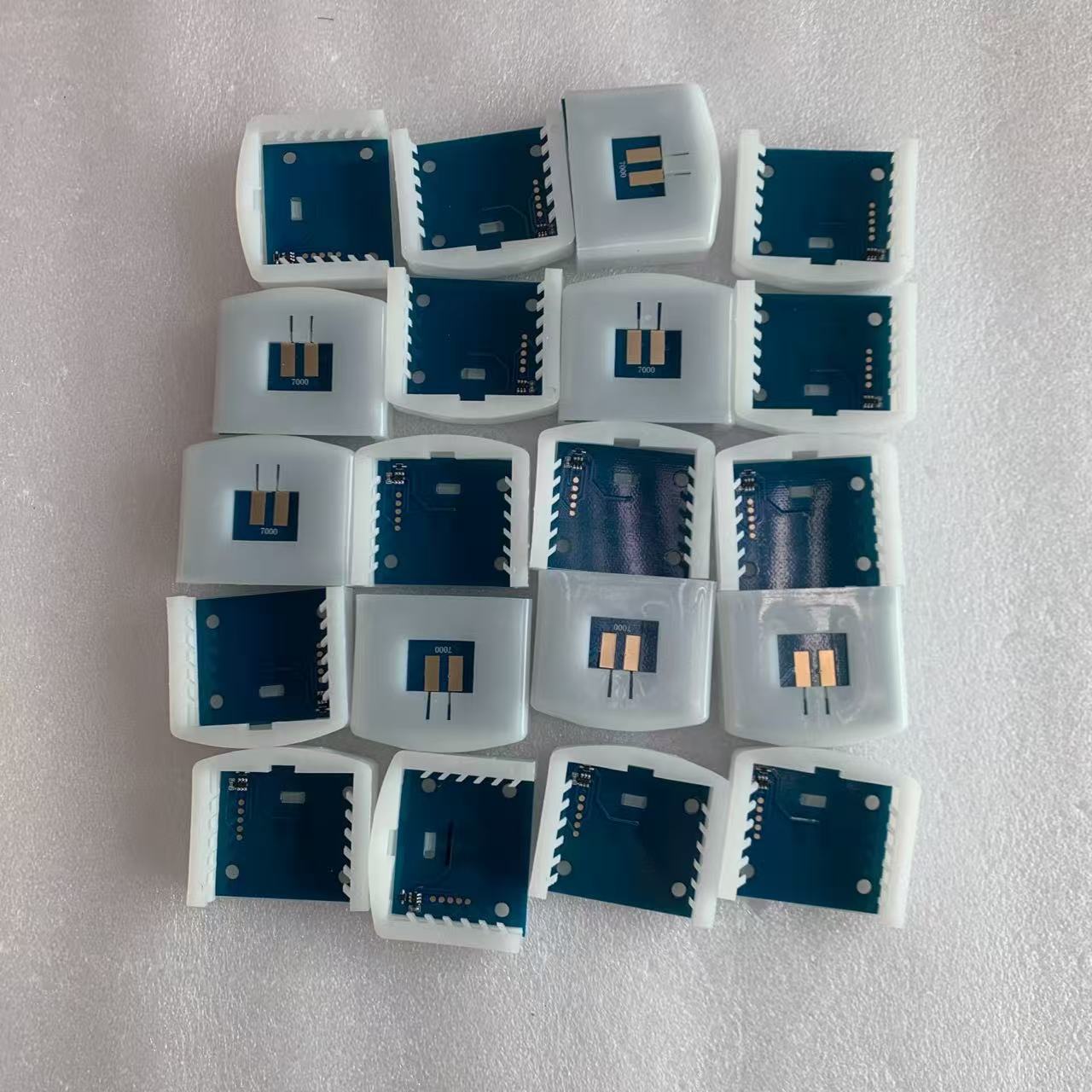
CIJ (Continuous Inkjet) printers use RFID chips embedded in ink cartridges and solvent (make-up) bottles as an intelligent consumable management system. Far from being just an anti-counterfeiting measure, these chips actively prevent the two biggest enemies of production lines: unplanned downtime and printing defects.
Every time a cartridge is installed, the printer's RFID reader module (typically operating at 13.56 MHz HF) communicates with the chip to exchange critical data:
The RFID chip stores a running counter of ink consumption. Instead of running until the ink runs dry mid-production (causing a printhead airlock and a lengthy reprime cycle), the printer can issue advance warnings at predefined thresholds — for example, "10% remaining — order replacement."
Without RFID, operators rely on visual checks or low-ink warnings that only trigger when ink is already exhausted. The difference can be 30+ minutes of downtime vs. a seamless 2-minute cartridge swap during a scheduled break.
CIJ printers continuously lose solvent to evaporation during operation. The printer uses solvent (make-up) to maintain ink viscosity within tight tolerances. RFID chips on the solvent bottle track consumption so the printer can automatically request a replacement before the solvent runs out.
A solvent-empty condition doesn't just stop printing — it causes ink viscosity to drift, leading to poor print quality and potentially clogged nozzles. RFID-based tracking eliminates this failure mode entirely.
Installing the wrong ink type is a costly mistake. For example, filling a solvent-based system with water-based ink can cause immediate printhead clogging and require complete system flushing. The RFID chip stores the ink formulation code, and the printer verifies compatibility before accepting the cartridge.
This cross-check eliminates operator errors that could otherwise cause hours of cleanup and rework.
Ink has a finite shelf life — typically 6-18 months depending on formulation. Expired ink can exhibit pigment settling, viscosity changes, or bacterial growth (for water-based inks). The RFID chip stores the manufacture date and expiry date. The printer will reject expired cartridges with a clear error message, preventing the print quality issues and downtime that would follow from using degraded ink.
This is especially critical in regulated industries (food, pharma) where batch traceability is mandatory.
Modern CIJ printers log RFID chip data to track consumable usage patterns. This data helps predict when maintenance will be needed — for example, a sudden increase in ink consumption may indicate a leak or printhead issue that needs investigation before it causes a breakdown.
Fleet management software can aggregate this data across multiple printers on a production line, enabling predictive maintenance scheduling.
Different substrates require different ink formulations — porous surfaces need fast-drying solvent inks, non-porous surfaces need adhesion-promoting formulations, and food packaging requires low-migration inks. The RFID chip ensures the printer only accepts the formulation programmed for that application.
This eliminates printing errors caused by ink-substrate mismatch, such as ink smearing, poor adhesion, or illegible codes.
Print quality in CIJ printers depends on maintaining precise ink viscosity. The RFID chip enables the printer to know the exact baseline viscosity of the installed ink and calculate the correct solvent addition rate. This prevents common print defects:
When a cartridge is installed, the RFID chip provides the printer with the optimal operating parameters for that specific ink: recommended printhead temperature, deflection voltage range, and pump pressure. This auto-configuration eliminates guesswork and ensures consistent print quality from the first drop.
Without RFID, operators would need to manually enter or adjust these parameters when switching ink types — a process that is error-prone and often results in dozens of rejected products before the settings are dialed in.
Counterfeit CIJ ink is a significant problem in many markets. Poor-quality counterfeit ink can contain incorrect solvent blends, particle contamination, or wrong pigment concentrations — all of which cause unpredictable print defects. The RFID chip's cryptographic authentication prevents counterfeit cartridges from being used.
Field data from major manufacturers shows that counterfeit ink is responsible for up to 40% of "mystery" print quality issues that operators cannot explain through normal troubleshooting.
Even genuine ink can have slight batch-to-batch variations. The RFID chip stores the lot number, allowing the printer to apply fine-grained calibration adjustments. If a print quality issue arises, the lot number provides a direct traceability link to the ink manufacturer's quality records.
This traceability is invaluable in regulated environments where any printing defect could trigger a product recall investigation.
| Scenario | Without RFID | With RFID |
|---|---|---|
| Ink runs out | Sudden stop, air in system, 20-40 min reprime | Advance warning, swap during break (2 min) |
| Wrong ink installed | System flush 1-2 hrs, potential head damage | Printer rejects cartridge, instant notification |
| Expired ink used | Clogging, rework, quality incident | Rejected before installation |
| Solvent empty | Viscosity drift, nozzle clog, 15-30 min fix | Pre-emptive alert, no interruption |
| Defect Type | Without RFID | With RFID |
|---|---|---|
| Ink splatter / satellite drops | Common with wrong viscosity | Viscosity auto-managed |
| Code illegibility | Parameter mismatch common | Auto-configured parameters |
| Ink adhesion failure | Wrong ink for substrate | Formulation enforced |
| Counterfeit-related defects | 40% of mystery defects | Cryptographic rejection |
While authentication is one function, the chips also actively improve production reliability. The ink formulation data, viscosity parameters, and predictive alerts directly reduce downtime and waste — benefits that save far more than the ink cost difference.
Manual checks are unreliable on fast production lines. Operators cannot monitor viscosity drift in real time, and visual ink level checks are often inaccurate for opaque cartridges. RFID provides continuous, accurate monitoring that manual processes cannot match.
This is a common complaint, but modern RFID systems have >99.9% read reliability under normal conditions. Most "RFID failures" are actually cartridge handling problems (dropped cartridges, improper seating, or using third-party chips with outdated firmware). With proper handling and genuine consumables, RFID-related downtime is negligible.
It tracks consumption via a counter that decrements based on actual printhead firing data. This is more accurate than float-based sensors, especially for small cartridges where surface tension effects make mechanical level sensing unreliable.
Genuine manufacturer chips are designed as single-use. The counter is stored in write-once or monotonic memory that cannot be reset. This is a deliberate design choice to ensure ink quality and traceability.
In food, pharma, and beverage industries, traceability is mandatory. RFID chips store lot numbers and expiry dates that can be logged by the printer for audit trails. This eliminates the risk of using undocumented or expired consumables in regulated production.
The basic principle is the same, but implementations differ. Markem-Imaje uses the RMCIJ1 module, Linx uses proprietary chips (1039, 1240, 1505, 1512 series), Domino uses i-Tech RFID cartridges, and Videojet uses Smart Cartridge systems. All serve the same core functions: authentication, ink type ID, and level tracking.
Most older CIJ printers (manufactured before ~2010) do not have RFID reader hardware. Retrofitting would require adding a reader module, antenna, and firmware updates. In most cases, upgrading to a newer printer model is more cost-effective than retrofitting.
Technical Guide — CIJ RFID Consumables Management
Always consult your printer manufacturer's official documentation for model-specific information.

Leave A Message
Scan to Wechat :

Scan to WhatsApp :

 English
 Pусский
 Español
 Português
 العربية
 فارسی
فارسی




 IPv6 network supported