
What Are You Looking For?
Fast-Dry vs Standard CIJ Ink Consumables: Which One Should You Use?
Category: CIJ Consumables | Published: July 8, 2026 | Reading time: ~5 min
One of the most common questions from production managers is whether to use fast-dry or standard CIJ ink. The answer is not about which one is better—it is about which one fits your specific application.
Choosing wrong can cause smeared codes, clogged nozzles, rejected products, and unnecessary downtime. This guide explains the differences and helps you pick the right one.
The Basic Difference
|
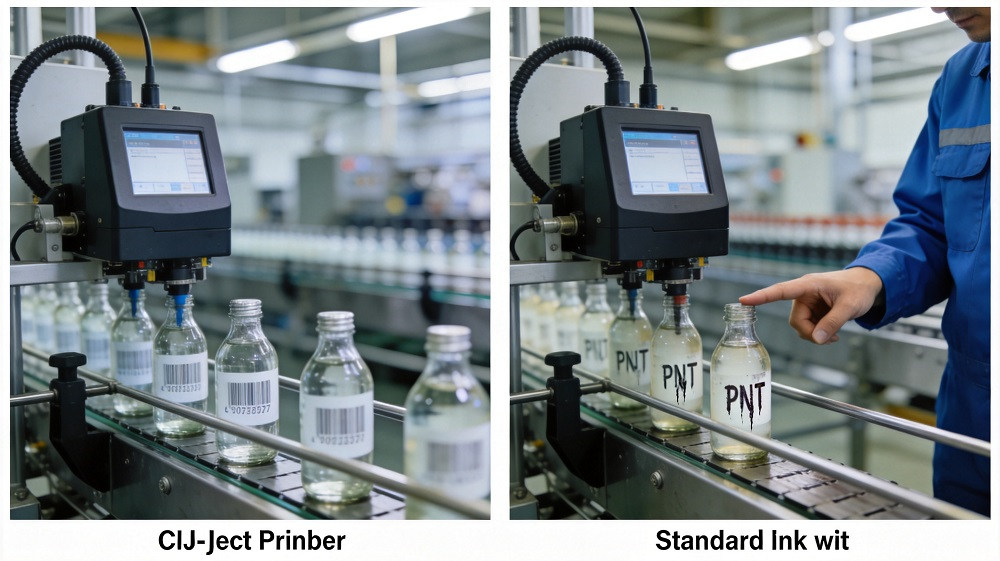
Fast-Dry Ink Uses a solvent blend with a high evaporation rate. The ink dries almost instantly upon contact with the substrate, typically in 0.1–0.5 seconds. This allows products to be handled, packed, or stacked immediately after coding. |
Standard Ink Uses a solvent blend with a moderate evaporation rate. The ink dries more slowly, typically in 1–5 seconds depending on substrate and ambient conditions. This gives the ink more time to bond with the surface. |
When to Use Fast-Dry Ink
Fast-dry ink is the right choice in these situations:
|
High-speed production lines — When products move at 200+ units per minute and enter packaging or stacking immediately after coding. Standard ink would still be wet when the next product touches it. Non-porous substrates — Glass, metal, plastic, and coated surfaces do not absorb ink. Fast-dry ink relies on evaporation alone to dry, which works well on these materials. Vertical or overhead printing — Codes printed on the bottom or side of products benefit from fast-dry ink because the ink is less likely to drip or run before drying. Washdown environments — Fast-dry formulations are often more resistant to moisture and condensation, making them suitable for cold fill and humid production areas. |
When to Use Standard Ink
|
Porous substrates — Cardboard, kraft paper, wood, and uncoated labels absorb standard ink into the surface fibers, creating a strong bond. Fast-dry ink may sit on top of the surface and rub off easily. Lower-speed lines — When there is enough time (3–5 seconds) before handling, standard ink provides better adhesion and readability at a lower cost. Cold environments — In refrigerated or cold storage facilities, fast-dry ink may dry too quickly on the nozzle face, causing clogging. Standard ink maintains better jet stability at lower temperatures. Cost-sensitive applications — Standard ink is typically 15–30% cheaper per liter than fast-dry ink. For high-volume applications where drying speed is not critical, the savings add up. |
Key Differences at a Glance
| Factor | Fast-Dry Ink | Standard Ink |
| Drying time | 0.1–0.5 seconds | 1–5 seconds |
| Best for | Non-porous surfaces, high speed | Porous surfaces, lower speed |
| Adhesion strength | Good on non-porous | Excellent on porous |
| Nozzle clogging risk | Higher — dries fast on nozzle face | Lower — stays wet longer |
| Cost per liter | Higher (15–30% premium) | Lower |
| Solvent consumption | Higher — more evaporation | Lower |
| Suitable for cold environments | No — increased clogging | Yes — better jet stability |
| Washdown resistance | Better | Moderate |
The Solvent Factor You Cannot Ignore
Fast-dry and standard inks use different solvent blends. This is important because the solvent must match your printer’s make-up fluid and system components.
|
Fast-dry inks typically use MEK (methyl ethyl ketone) or acetone-based solvents. These evaporate rapidly but are more aggressive on seals and require compatible O-ring materials (Viton or PTFE). Standard inks often use ethanol or alcohol-based solvents. These are gentler on system components but require longer drying time. Never mix fast-dry and standard inks in the same system. The different solvent bases can react and form gel-like deposits that clog filters and damage the pump. |
How to Make Your Decision
Use this simple decision flow to choose:
| Question | If Yes | If No |
| Is your line speed above 150 units/min? | Fast-Dry | Consider both |
| Is your substrate non-porous (glass, metal, plastic)? | Fast-Dry | Standard |
| Do products enter packaging immediately after coding? | Fast-Dry | Consider both |
| Is your production area cold or humid? | Standard | Consider both |
| Do you need washdown resistance? | Fast-Dry | Consider both |
| Is cost reduction a priority? | Standard | Consider both |
Practical Tips for Switching
If you need to switch from standard to fast-dry ink (or vice versa), follow these steps to avoid contamination:
|
CIJ |
CIJ Insights Team Practical knowledge on CIJ printer consumables, ink selection, and industrial coding for manufacturing professionals. |

Leave A Message
Scan to Wechat :

Scan to WhatsApp :

 English
 Pусский
 Español
 Português
 العربية
 فارسی
فارسی




 IPv6 network supported