
What Are You Looking For?
What Are the Most Critical Inkjet Printer Spare Parts You Should Replace Regularly?
What Are the Most Critical Inkjet Printer Spare Parts You Should Replace Regularly?
Category: CIJ Printer Maintenance | Published: June 18, 2026 | Reading time: ~8 min
Continuous Inkjet (CIJ) printers are the workhorses of industrial coding and marking. From food and beverage packaging to pharmaceutical labeling and electronics manufacturing, these machines run relentlessly to apply batch codes, expiration dates, barcodes, and 2D Data Matrix codes on production lines moving at high speed.
But like any precision mechanical system, CIJ printers rely on a network of wear-prone components that degrade over time. A single clogged filter or worn pump seal can cascade into print quality failures, costly downtime, and rejected product batches. Proactive spare part replacement is the single most effective strategy to prevent these failures before they happen.
In this guide, we break down the most critical CIJ inkjet printer spare parts you should replace on a regular schedule, explain why each part matters, and provide recommended replacement intervals based on industry best practices.
Understanding CIJ Printer Mechanics: Why Parts Wear Out
Before diving into specific spare parts, it helps to understand how a CIJ printer works internally. A CIJ system continuously pumps ink from a main tank through a series of filters, pressure regulators, and a gear pump before forcing the ink through a microscopic nozzle (typically 40–80 microns in diameter). An oscillating crystal breaks the continuous ink stream into individual droplets, which are then electrically charged and deflected by electrostatic plates to form characters on the substrate.
Unprinted droplets are caught by a gutter and returned to the ink system through a recovery line. This closed-loop circulation means ink passes through pumps, valves, filters, and the nozzle head continuously during operation—and every component in that path is subject to mechanical wear, chemical degradation from solvents, and contamination buildup.
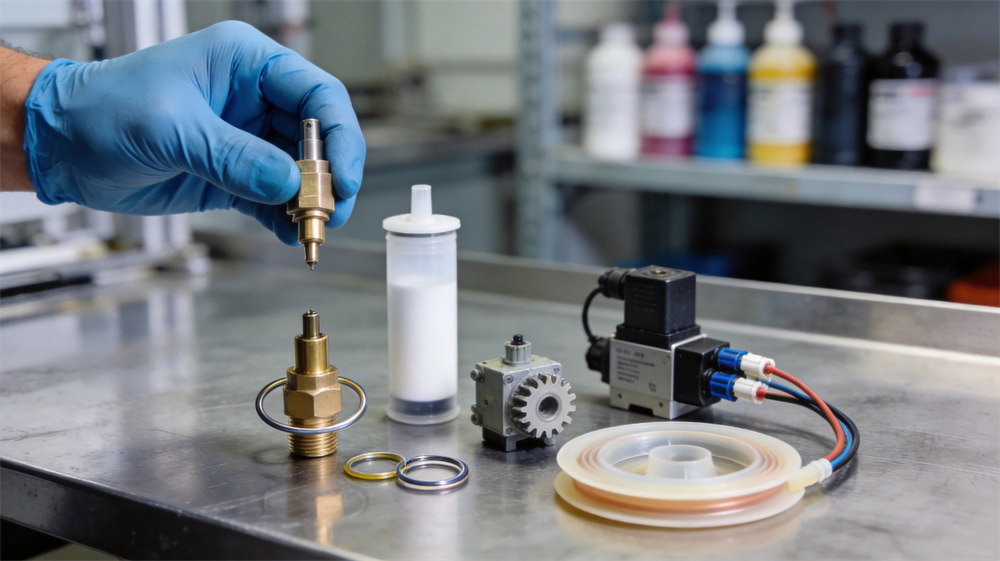
The 8 Most Critical CIJ Printer Spare Parts to Replace Regularly
|
The printhead nozzle is arguably the most precision-critical component in the entire CIJ system. Typically machined from sapphire, ruby, or tungsten carbide with a bore diameter of 40–80 microns, the nozzle determines droplet formation, jet stability, and ultimately print quality. Over time, the nozzle bore can erode from the high-velocity ink stream, accumulate dried ink deposits on its face, or suffer micro-damage from improper cleaning procedures. Even a slight deviation in the nozzle’s geometry—a few microns of enlargement—can cause droplet misplacement, poor code legibility, and satellite droplets that leave stray marks on the product. Why replacement matters: A degraded nozzle cannot be restored to its original precision. While regular cleaning helps extend nozzle life, replacement is the only way to restore factory-spec droplet formation. Replace every 6–12 months or 3,000–5,000 operating hours |
|
2. Ink System Filters (Main, Make-up, and Gutter) CIJ printers use multiple filter stages throughout the ink circulation path to remove contaminants, pigment agglomerates, and debris that could clog the nozzle. The three primary filters include:
When filters become saturated, they restrict ink flow, forcing the gear pump to work harder. This raises system pressure, accelerates pump wear, and can ultimately cause pump seizure—a much more expensive failure than a simple filter swap. Replace main filter every 1,000–2,000 hours; make-up and gutter filters every service cycle |
|
3. Gear Pump and Pump Seals The gear pump (sometimes called a crescent pump) is the heart of the CIJ ink circulation system. It pressurizes the ink to drive it through the nozzle at high velocity. Inside the pump, precision-machined gears rotate in a closely fitting housing, and the gaps between gears and housing are sealed by the ink film itself—making any wear immediately impactful. Pump gears experience gradual wear from the abrasive nature of pigment particles in the ink, and the pump seals degrade over time due to continuous exposure to aggressive solvents (MEK, ethanol, acetone). Symptoms of pump wear include inconsistent pressure, fluctuating jet speed, poor droplet break-off, and eventual pump failure. Pro tip: Many pump assemblies are available as rebuild kits that include new gears, seals, and diaphragm components—significantly cheaper than replacing the entire pump assembly. Replace pump assembly every 4,000–6,000 hours; seals every 2,000–3,000 hours |
|
4. Solenoid Valves (Recovery and Shut-off) CIJ systems rely on solenoid valves for two critical functions: controlling the recovery/gutter return line (recovery solenoid) and managing ink shut-off during start-up, shut-down, and fault conditions (shut-off solenoid). These electromagnetic valves operate thousands of times per day in a fast-cycle production environment. The internal valve seats, springs, and plunger mechanisms are subject to wear, and the electrical coils can degrade from heat. A failing solenoid valve can cause ink leaks, poor gutter recovery, pressure fluctuations, and failed start-up sequences. Replace every 3,000–5,000 hours or at signs of sluggish response |
|
5. Diaphragm Assembly The diaphragm serves as the flexible barrier between the ink system and the pneumatic or mechanical drive mechanism. It continuously flexes during operation to maintain ink pressure and assist with circulation. Made from elastomeric materials (typically PTFE-coated rubber or fluoropolymer composites), diaphragms gradually lose elasticity, develop cracks, or pinhole leaks due to solvent attack. A compromised diaphragm leads to pressure instability, solvent leaks into the ink system (contaminating the ink), or air ingress that disrupts droplet formation. Replace every 2,000–3,000 hours or at every major service |
|
6. Deflector Electrode Assembly The deflector assembly consists of two charged plates positioned on either side of the ink jet stream. By applying a voltage differential, the deflector bends charged droplets into the correct position on the substrate. This assembly is exposed to ink overspray, solvent vapors, and environmental contaminants that build up as a conductive film on the electrode surfaces. Contaminated deflector plates cause inconsistent deflection angles, blurred or misaligned prints, and erratic code positioning. While regular cleaning helps, the insulating coatings on the plates degrade over time and eventually require replacement. Replace every 3,000–5,000 hours |
|
7. Pressure Transducer / Sensor The pressure transducer monitors ink system pressure in real time and feeds data to the printer’s control electronics. Accurate pressure monitoring is essential for maintaining the correct droplet velocity and charge-to-mass ratio. Pressure transducers in CIJ printers are exposed to continuous solvent contact and mechanical vibration. A drifting or failed pressure sensor can cause the printer to operate at incorrect pressure, leading to jet instability, poor print quality, or false error codes that halt production. Replace every 4,000–6,000 hours or when calibration drifts beyond spec |
|
8. Charge Electrode and Crystal Oscillator The charge electrode (also called the charging tunnel) imparts an electrical charge to each droplet as it passes through. The crystal oscillator (piezoelectric crystal) creates the vibrations that break the continuous ink stream into uniformly sized droplets at the correct frequency. Charge electrodes accumulate ink residue over time, which can distort the charging field. The crystal oscillator is a solid-state component but can shift frequency due to thermal cycling, contamination buildup, or aging. Either component failure results in missing dots, incorrect dot placement, or complete jet failure. Charge electrode: clean regularly, replace every 2,000–3,000 hours; Crystal: replace if frequency drifts |
Quick Reference: Recommended Replacement Schedule
| Spare Part | Recommended Interval | Failure Risk If Overdue |
| Printhead Nozzle | 6–12 months / 3,000–5,000 hrs | Poor print quality, illegible codes |
| Main Ink Filter | 1,000–2,000 hrs | Flow restriction, pump overwork, nozzle clogging |
| Make-up / Gutter Filters | Every service cycle | Contamination circulation |
| Gear Pump Assembly | 4,000–6,000 hrs | Pressure loss, complete circulation failure |
| Pump Seals / Diaphragm | 2,000–3,000 hrs | Leaks, pressure instability |
| Solenoid Valves | 3,000–5,000 hrs | Ink leaks, failed start-up |
| Deflector Assembly | 3,000–5,000 hrs | Misaligned prints, blurred codes |
| Pressure Transducer | 4,000–6,000 hrs | False error codes, pressure instability |
| Charge Electrode | 2,000–3,000 hrs | Missing dots, incorrect charging |
| Note: The intervals above are general guidelines based on typical CIJ operation in standard industrial environments. Always refer to your specific printer manufacturer’s maintenance manual (Videojet, Domino, Markem-Imaje, Linx, Hitachi, etc.) for model-specific replacement schedules, as recommendations vary significantly between brands and ink formulations. |
Best Practices for Spare Part Management
Keep a Critical Spares Inventory
Never wait for a failure to order parts. Maintain an on-site inventory of at least the following consumables and wear parts:
Track Operating Hours, Not Calendar Time
Replacement schedules should be based on actual operating hours, not wall-clock time. A CIJ printer running 24/7 in a high-speed beverage plant accumulates wear far faster than the same model running 8 hours per day in a low-volume packaging facility. Use your printer’s built-in hour meter or log start/stop times to track true runtime.
Use OEM or Certified Aftermarket Parts
While aftermarket spare parts can offer cost savings, critical components like nozzles, pumps, and deflector assemblies should come from OEM sources or certified suppliers that meet the manufacturer’s material and dimensional specifications. A sub-standard nozzle with a slightly oversized bore or a filter with inconsistent micron ratings can cause chronic issues that cost far more than the savings.
Perform Scheduled Overhauls
Most CIJ printer manufacturers recommend a full preventive maintenance overhaul at specific intervals (typically annually or every 4,000–6,000 hours). During an overhaul, a trained technician replaces all wear parts simultaneously, recalibrates the system, cleans the ink path, and verifies print quality to factory standards. Scheduling overhauls during planned downtime (maintenance windows, shift changes, or seasonal slowdowns) prevents unexpected breakdowns during peak production.
|
Reduce CIJ Downtime by 90% with Preventive Maintenance Studies show that over 90% of CIJ printer downtime is caused by preventable part failures. By replacing these critical spare parts on a regular schedule, you can dramatically reduce unplanned stoppages, extend printer lifespan, and maintain consistent code quality across your production lines. |
Conclusion
A CIJ inkjet printer is only as reliable as the components inside it. By understanding which parts wear out fastest—nozzles, filters, pumps, valves, diaphragms, deflectors, sensors, and charge electrodes—and implementing a disciplined replacement schedule, you can stay ahead of failures and keep your coding operations running at peak performance.
The cost of a preventive spare part replacement is always a fraction of the cost of an unplanned production shutdown, product rework, or regulatory non-compliance from unreadable codes. Invest in your spare parts inventory, track your operating hours, and make maintenance a non-negotiable part of your production workflow.
|
CIJ |
CIJ Insights Team Dedicated to sharing practical knowledge on continuous inkjet printer technology, maintenance best practices, and industrial coding solutions for manufacturing professionals worldwide. |

Leave A Message
Scan to Wechat :

Scan to WhatsApp :

 English
 Pусский
 Español
 Português
 العربية
 فارسی
فارسی




 IPv6 network supported