
What Are You Looking For?
Printing White: High-Contrast CIJ Codes on Dark and Metallic Packaging
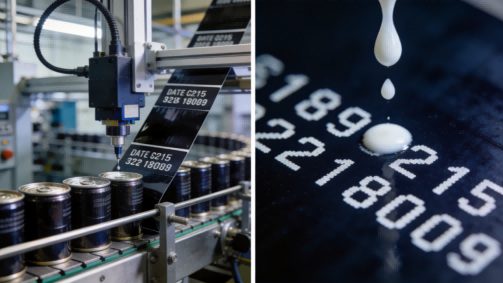
For years, dark packaging was the enemy of CIJ coding. Black ink vanished on black film, dark glass, and metal components — leaving codes unreadable and traceability compromised. The solution? White ink. But white pigment is notoriously tricky: it settles, clogs, and demands careful handling.
This guide breaks down how white CIJ ink works, when it earns its premium, and how to keep it running reliably on your line.
White ink solves a fundamental problem: contrast on dark surfaces. When your packaging is black, dark gray, metallic, or colored, standard black dye ink becomes invisible. White pigment ink creates the bold, high-contrast mark that scanners, quality checks, and consumers can actually read.
Where white ink earns its place:
1. Dark film and pouches — black flow-wrap film, coffee pouches, char-black packaging.
2. Metallic and dark cans — beverage cans, aerosol cans with dark or colored finishes.
3. Dark glass bottles — premium spirits, dark wine, and colored cosmetic bottles.
4. Cables and industrial parts — dark insulation, colored polymer, and metal components.
5. Flexible packaging — foil laminates and colored films where black ink disappears.
|
Substrate |
Problem with Black Ink |
White Ink Solution |
|
Black PE/PP film |
Invisible code |
Bold white contrast |
|
Dark metallic cans |
Fades into finish |
High-opacity white mark |
|
Dark glass bottles |
Unreadable on dark glass |
Crisp white characters |
|
Colored cables / parts |
Low contrast |
White stands out clearly |
|
Foil laminates |
Reflective interference |
White breaks through |
Not all white inks are the same. The most important distinction for CIJ users is between hard and soft pigmented formulations.
|
Type |
Pigment |
Maintenance |
Best For |
|
Hard pigmented |
Dense, larger particles |
Higher clogging risk |
Demanding adhesion, extreme durability |
|
Soft pigmented |
Fine, more stable |
Behaves like dye ink |
Everyday high-contrast coding |
Key principle: Soft-pigmented white ink offers the high contrast of pigment with the handling ease of dye-based ink — the practical choice for most production lines.
Trend to watch: Next-generation dedicated contrast printers (like VJ's 1880 C) use soft-pigmented inks that perform like dye-based printers — delivering white contrast with far less maintenance than traditional pigmented systems.
White ink's greatest weakness is pigment sedimentation. Unlike dye ink, where color dissolves into the liquid, pigment particles are solid — and they settle, build up, and clog.
Three problems white ink users face:
1. Sedimentation. Pigment settles in the line when circulation stops or slows, especially after shutdown.
2. Nozzle clogging. Settled pigment blocks tiny nozzles, causing missing characters or faded codes.
3. Reduced uptime. Traditional pigmented printers need frequent cleaning and service, cutting into production.
How modern systems address this:
1. Dual-circulation systems keep pigment suspended continuously, reducing settling.
2. Automatic cleaning cycles purge the printhead when needed, not on a fixed schedule.
3. Stable viscosity management adjusts for temperature shifts that otherwise trigger pigment dropout.
Key reminder: Pigment particle size matters. For CIJ nozzles, pigment must be filtered to below 1 μm to prevent clogging — always verify the ink meets your printhead's spec.
Choosing white ink isn't just about picking a color. Match it to your application and line conditions.
|
Factor |
Consideration |
|
Substrate |
Dark film, metal, glass, cable — each needs specific adhesion |
|
Line speed |
Higher speed needs faster-drying white ink |
|
Durability |
Abrasion / washdown resistance for harsh handling |
|
Coder compatibility |
Viscosity, conductivity, pigment size must match |
|
Maintenance tolerance |
Soft-pigmented if you want lower cleaning frequency |
Key selection questions to ask:
1. What's the substrate? Dark film needs different white ink than metal or glass.
2. How fast is the line? Drying speed must match throughput.
3. How long between shutdowns? Longer shutdowns need inks that resist settling.
4. What's your maintenance budget? Soft-pigmented cuts cleaning but may cost more.
Even with the right ink, problems arise. Here's how to diagnose and fix the most common ones.
|
Symptom |
Likely Cause |
Recommended Action |
|
Faded / low opacity |
Ink too diluted; low pigment |
Verify pigment concentration; adjust |
|
Missing characters |
Nozzle clogged with pigment |
Run purge cycle; clean nozzle plate |
|
Ink settling in line |
Circulation stopped too long |
Improve circulation; avoid long idle |
|
Smearing on line |
Drying too slow |
Switch to faster-dry white ink |
|
Poor adhesion |
Wrong ink for substrate |
Match ink to substrate chemistry |
1. Substrate identified (dark film, metal, glass, cable)
2. Line speed and print window calculated
3. Hard vs. soft pigmented decision justified
4. Pigment particle size within nozzle spec (<1 μm)
5. Drying speed matched to line speed
6. Coder compatibility confirmed (approved list)
7. Abrasion / durability needs verified
8. Make-up solvent matched to ink brand
9. Maintenance tolerance assessed (soft vs. hard)
10. Sample tested on your actual line for 1+ week
1. White ink solves the dark-surface problem — delivering high contrast where black ink disappears.
2. Soft-pigmented white ink is the practical choice — high contrast with dye-like handling ease.
3. Pigment settling is the biggest challenge — choose systems with dual circulation and automatic cleaning.
4. Match white ink to your substrate and line speed — one formulation doesn't fit all.
5. Dedicated contrast printers are the trend — soft-pigmented systems reduce maintenance significantly.
6. Always sample-test on your real line before committing — white ink behavior varies by application.
Getting high-contrast white codes right doesn't have to be a struggle. Kingsfang supplies a complete range of CIJ coding consumables — including pigmented and compatible inks for dark and metallic surfaces.
What we offer:
1. Pigmented CIJ inks — including white and other high-contrast options for dark substrates, compatible with Domino, VJ, Markem-Imaje, and Linx systems.
2. Complete consumable range — printheads, nozzles, ink cores, RFID chips, filters, and cleaning solutions across a 1,000+ product catalog.
3. OEM / private labeling — for distributors and service companies building their own brand.
4. Reliable supply — 15,000 m² of factory and warehouse space, 500,000+ units annual capacity, serving 60+ countries.
Looking for the right white or pigmented ink for your line? Contact the Kingsfang team for a catalog, price list, or application guidance at sales@kingsfang.com — or visit www.kingsfang.com to get started.
Why work with Kingsfang:
· Stable quality with strict QC and CE/ISO-certified manufacturing
· Cost-effective solutions that help partners save 20–30% on consumables
· Global service for distributors, service companies, and manufacturers
· Real manufacturing capability — not just a trading company
Ready to make the switch to high-contrast white coding? Get in touch today. Kingsfang is here to help you get it right.

Leave A Message
Scan to Wechat :

Scan to WhatsApp :

 English
 Pусский
 Español
 Português
 العربية
 فارسی




 IPv6 network supported